How Korea Pulled Ahead
Part four of a Harvard-style case series on what builds nations: in 1965 Pakistan and South Korea stood on the same line. A monthly scoreboard, an export condition on every subsidy, a steel mill built to compete and scientists called home made the difference.
When I went to Lahore for my BCS, the college ran on semesters.
An exam every four months. Every four months I knew exactly where I stood.
Where I came from, the answer came once every two years. And by then the answer had already become the verdict.
That difference was everything.
What gets measured often starts getting better.
Today’s case is a country that ran an entire nation on that principle. A reckoning every month, for fourteen years.
South Korea.
First, a number
From 1961 to 1966, income per person in both Pakistan and Korea stayed between 90 and 150 dollars a year.
In 1965, on paper, we were ahead. The average Pakistani earned 114 dollars a year, the average Korean 109.
Today Korea stands at 36,239 dollars. We stand at 1,479.
A gap of about twenty-four times. In one generation.
In those years the world called Pakistan a model of development. Harvard economists sat inside our Planning Commission drafting plans.
You often hear that Korea took our five-year plan home and built its country with it.
I looked for solid proof. I did not find it. So I will not make that claim.
But this much is certain: we started from roughly the same line.
And Korea was not better placed than us.
Thirty-five years of Japanese occupation. Then a brutal war from 1950 to 1953. A country split in two. No oil, no great mineral wealth. A country living on American aid.
In 1960 the whole country exported just 33 million dollars.
So the question is the same one. How did this happen?
The man at the decision
In 1961 a general, Park Chung-hee, seized power in a military coup.
I will not hide this. He was a hard ruler. He crushed dissent. And in 1979 he was shot dead by his own intelligence chief.
At this point a Pakistani reader will say at once: then we need a general like that too.
Stop.
We had a general in the same years. There was growth too. But it did not compound.
The difference was not the uniform. The difference was what got measured, and what carried on afterward.
Korea became a democracy in 1987, and growth did not stop. The system that had been built kept running after governments changed.
That is continuity. And that was the first pillar of our framework.
Four decisions
One: one scoreboard, every month
From February 1965, Park called a meeting every month. The export meeting.
Ministers, the central bank, the big banks, the big companies, the trade bodies, all in one room.
Every sector and every company had a written target. Every month they looked at who was ahead, who was behind, and who was blocking whom.
By October 1979 the meeting had been held 152 times. Park sat in 147 of them himself.
Fourteen years. Every month. The same question.
A company that could sell abroad got cheap credit and support. A company that could not saw that support shrink.
Help came with one condition. Go and compete in the world market.
To me this is the single biggest difference. Our industry got protection too, but often with no condition attached.
On 30 November 1964 Korea’s exports crossed 100 million dollars for the first time. The day is still remembered as Trade Day.
In 2024 those exports were 683.8 billion dollars.
Two: learn first, then build
At first Korea sold what it could make. Textiles, shoes, wigs, cheap goods.
Then, with those earnings and that learning, the next rung. Steel, ships, cars, then electronics, then chips.
In 2024 Korea sold 141.9 billion dollars of semiconductors alone.
This is the same apprenticeship we saw in China. The factory floor was the school.
Three: two steel mills, one year
This is the part of the case that stings me most.
In 1968 Korea set up a steel company. POSCO.
Foreign lenders pulled back. The money did not come.
So Korea took the money it had received from Japan as compensation under the 1965 treaty and put it into this plant, along with Japanese loans and technology.
The first steel came out in June 1973. Today POSCO counts among the world’s major steelmakers.
That same year, in July 1968, Pakistan Steel Mills was incorporated.
Its first blast furnace was lit in 1981. Since June 2015 production has stopped.
Two births in the same year.
One had to compete in the world from day one. The other was never given that condition.
Four: call the minds home
In 1966 Korea set up a research institute, KIST.
Its first head went to the United States and brought Korean scientists working abroad home, one by one. Eighteen in the first year alone.
They were paid two to three times what university professors earned, given housing, and given freedom to research.
This is the sea-turtle story, forty years before China.
And it did not stop. Today Korea spends nearly five percent of its national income on research. Pakistan, 0.16 percent.
What it cost
This story is not honest without the price.
It was a dictatorship. Workers’ voices were suppressed. In 1980 in Gwangju the army opened fire on protesting citizens.
Wealth concentrated in a few family-run conglomerates. Koreans call them chaebol.
In 1997 the debt burden burst, and Korea had to take the largest loan the IMF had ever approved up to that time.
But in that same crisis the world saw a remarkable scene.
About three and a half million Koreans queued up with their gold. Wedding rings, gifts given to their children, medals. Roughly 227 tonnes of gold handed over to help pay the nation’s debt.
That was trust. The fifth pillar of our framework, in the shape of a queue.
And there is a price today. In 2024 the average Korean woman had 0.75 children, among the lowest rates in the world.
That race made a nation rich, and it also wore it out.
Lessons for Pakistan
Where does Korea sit on the five pillars?
Pillar one, continuity. Fourteen years, the same question every month. And the same direction after democracy arrived.
Pillar three, apprenticeship before invention. From wigs to chips. Each rung paid for and taught by the one below.
Pillar four, the diaspora as builder. KIST called the minds home, with respect and with labs.
Pillar five, trust. Those queues of gold.
And four concrete things for us:
One. Pick one number and make it the nation’s scoreboard. In my view, that number is exports. In FY2025 Pakistan exported 32.1 billion dollars, roughly 130 dollars per Pakistani. Korea exports about 13,200 dollars per person. A hundredfold gap.
Two. Hold that meeting every month, with the country’s top office-holder in the room. Governments change; the meeting does not.
Three. One condition for support: sell abroad and show it. Our freelancers and IT companies are already doing this. Take them to the next rung.
Four. Our own KIST. The hundred best Pakistani scientists and engineers working abroad, brought home with full respect, labs and pay.
Exhibits
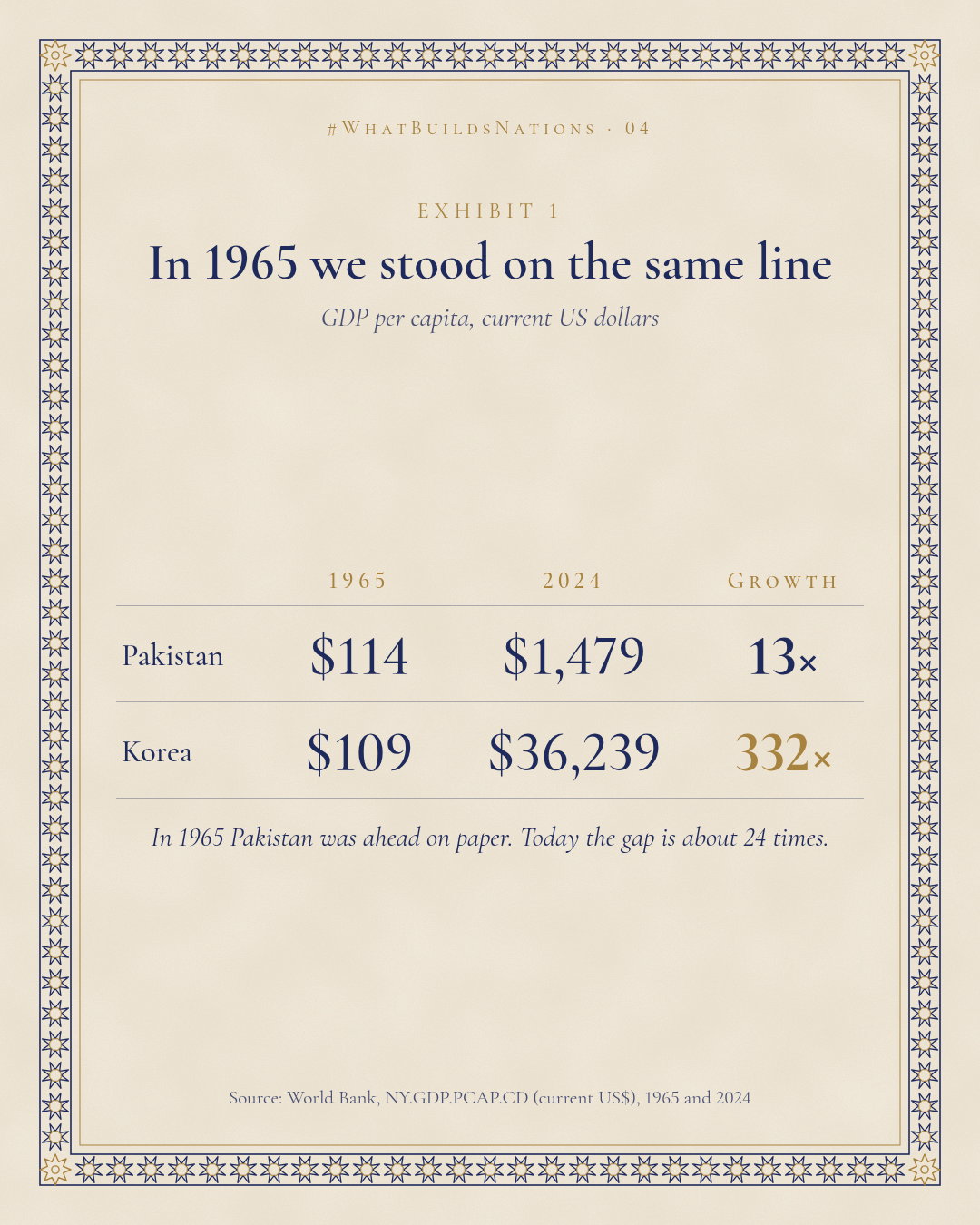
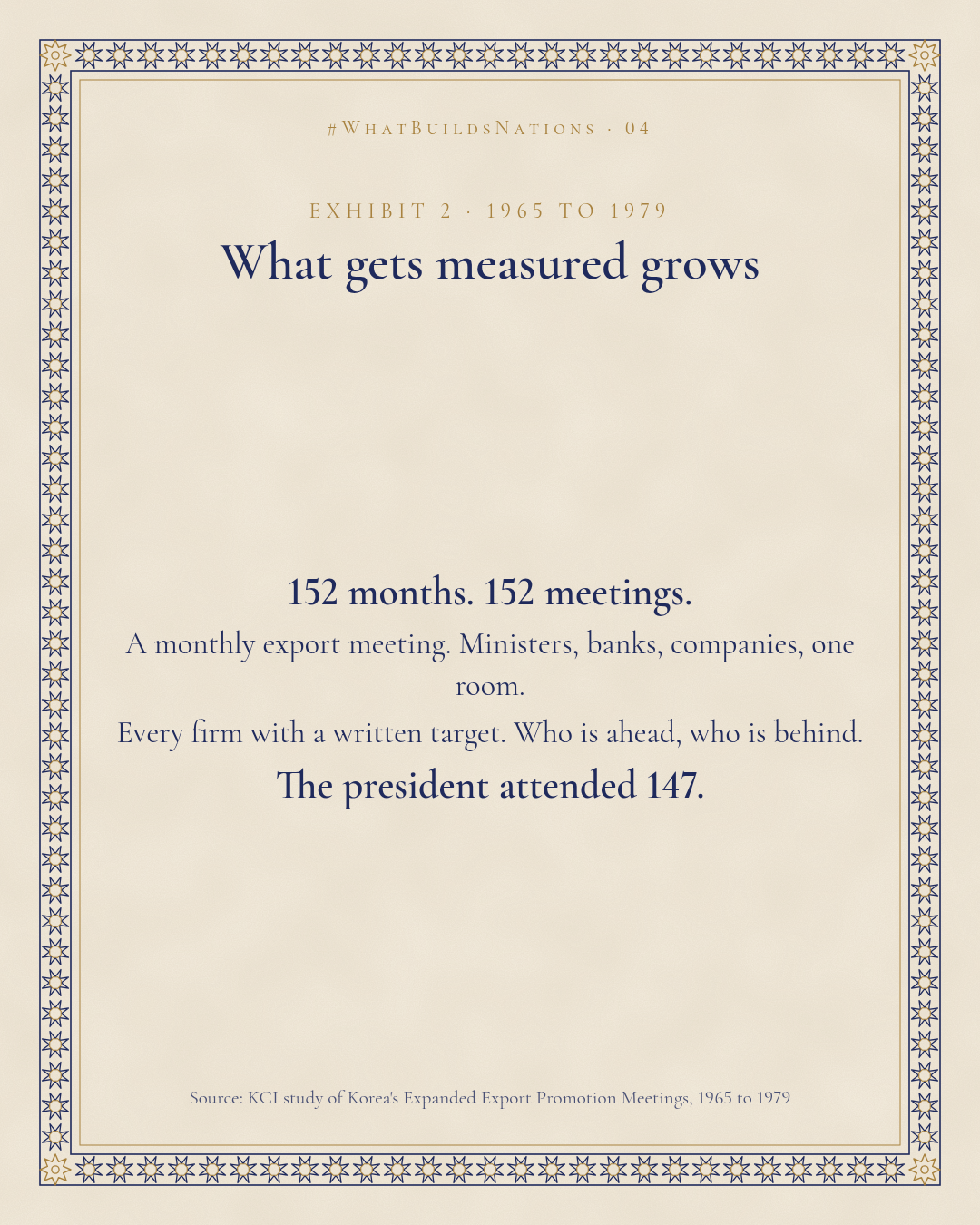
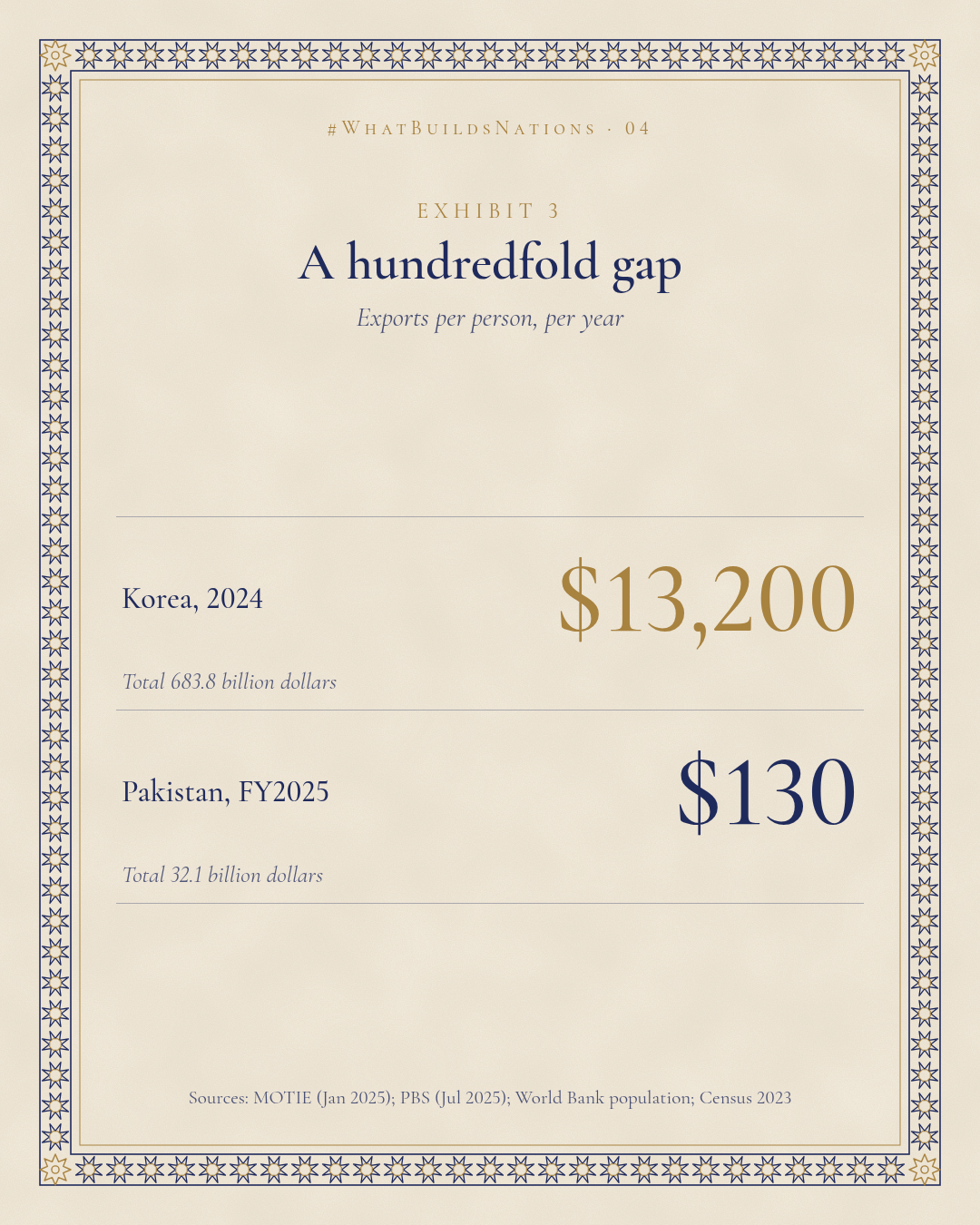
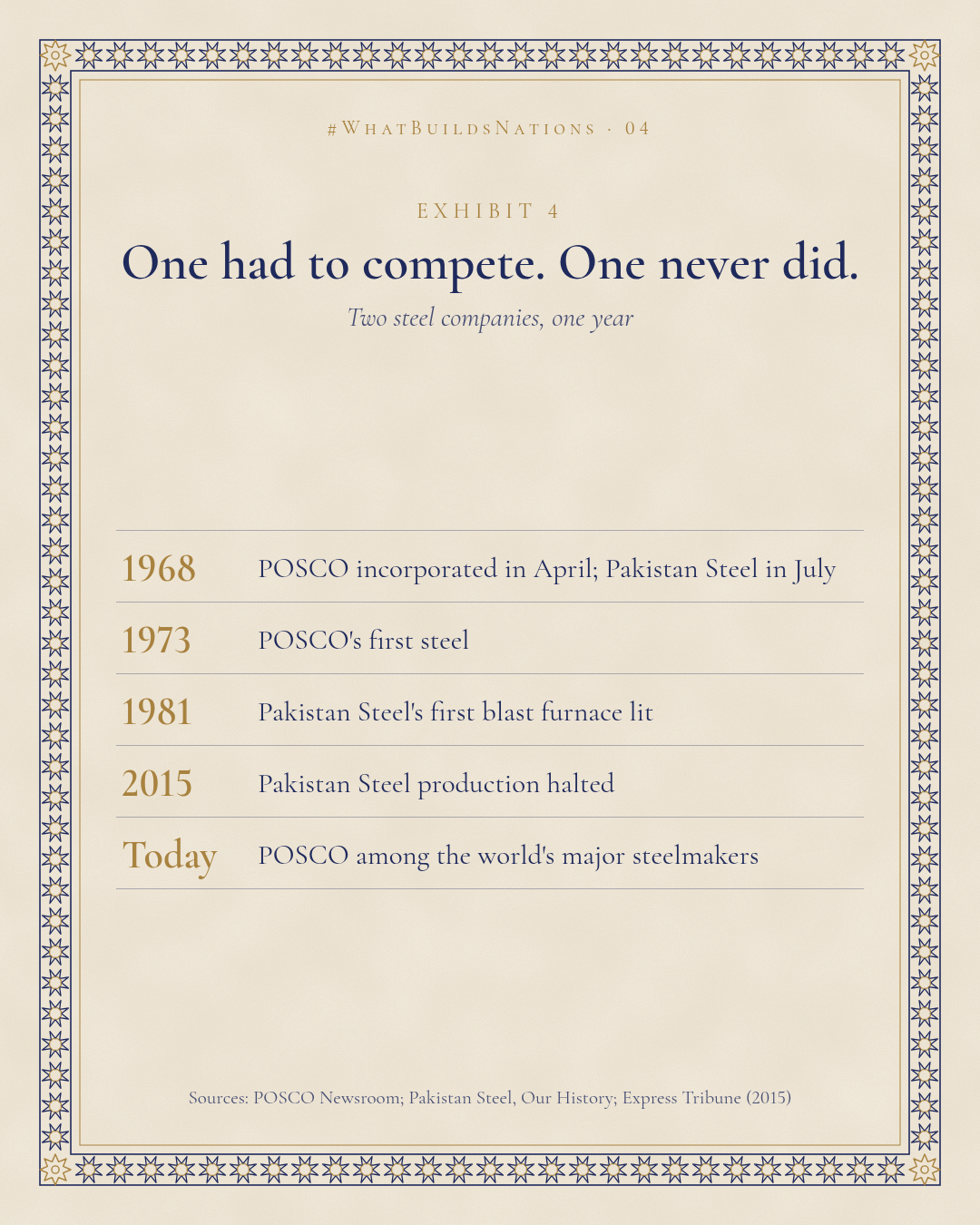
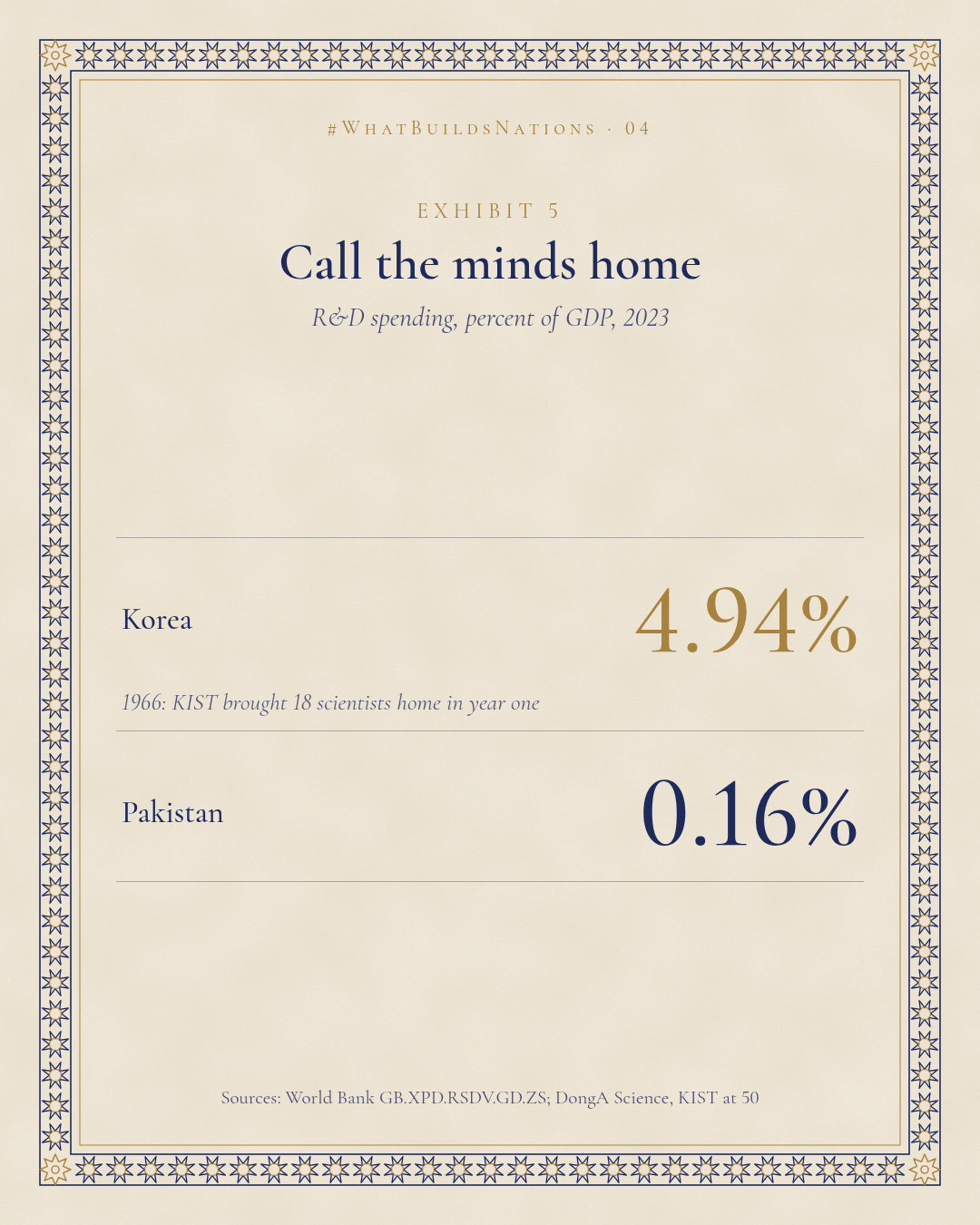
Exhibit 1. GDP per capita, current US dollars
| Year | Pakistan | South Korea |
|---|---|---|
| 1960 | 82 | 159 |
| 1965 | 114 | 109 |
| 1970 | 167 | 282 |
| 2024 | 1,479 | 36,239 |
An honest note. Part of the 1965 gap came from the fall in the Korean won. The real point is that through the 1960s the two countries hovered around the same line. Source: World Bank.
Exhibit 2. Exports
| Korea | Pakistan | |
|---|---|---|
| 1960 | 33 million dollars | |
| 1964 | 100 million dollars (30 November) | |
| 2024 / FY2025 | 683.8 billion dollars | 32.1 billion dollars |
| Per person | about 13,200 dollars | about 130 dollars |
Exhibit 3. Two steel mills, one year
| POSCO | Pakistan Steel Mills | |
|---|---|---|
| Incorporated | April 1968 | July 1968 |
| First steel / first blast furnace | June 1973 | August 1981 |
| Today | Among the world’s major steelmakers | No production since June 2015 |
Exhibit 4. Research and human capital
| Korea | Pakistan | |
|---|---|---|
| R&D spending, percent of GDP (2023) | 4.94 | 0.16 |
| Human Capital Index (2020) | 0.80 | 0.41 |
| Learning-adjusted years of school (2020) | 11.7 | 5.1 |
Exhibit 5. A reckoning every month
From February 1965 to October 1979: 152 monthly export meetings. The president attended 147.
The last word
There is no magic in Korea’s story.
One number was chosen. It was measured every month. Support was tied to performance. And the chain did not break when governments changed.
I learned the same thing from those four-month semesters in Lahore. When the answer comes early, you correct early.
Nations are no different.
In 1965 we stood on the same line. Today’s gap was not written by fate. It is the account of sixty years of decisions.
And the account of the next sixty is still open.
Three questions for you
- If Pakistan could measure only one number every month, which should it be? Exports? Children’s learning? Something else?
- Korea and Pakistan both set up a steel company in 1968. One became a global major, the other sits idle. What do you think the real difference was?
- Korea’s rapid rise came at the price of dictatorship, relentless pressure and today the world’s lowest birth rate. Is growth that fast possible without that price?
Next in the series
Bangladesh.
The country that separated from us in 1971, and is now ahead of us in income per person.
That stings. Which is exactly why it needs reading.
Sources
- World Bank, World Development Indicators: GDP per capita, current US$ (NY.GDP.PCAP.CD), 1960 to 2024; population (SP.POP.TOTL) 2024; R&D expenditure (GB.XPD.RSDV.GD.ZS) 2023; Human Capital Index 2020.
- Douglas A. Irwin, “From Hermit Kingdom to Miracle on the Han”, NBER Working Paper 29299 / PIIE WP 21-14 (2021).
- Monthly export meetings, 147 of 152 attended: KCI paper on the Expanded Export Promotion Meetings, 1965 to 1979.
- IMF Finance & Development, “Korea’s Export Success, 1960-69” (1971); National Archives of Korea, Export Day, 30 November 1964.
- Ministry of Trade, Industry and Energy (MOTIE), 1 January 2025: 2024 exports of 683.8 billion dollars, semiconductors 141.9 billion dollars.
- Pakistan Bureau of Statistics / APP, July 2025: FY2025 exports of 32.1 billion dollars; Census 2023: population 241.5 million.
- POSCO Newsroom (incorporation 1968, first steel 9 June 1973); Nippon.com and KCI on POSCO financing and the Japanese claims fund.
- Pakistan Steel, “Our History” (2 July 1968, 14 August 1981); Express Tribune, June 2015, gas cut and production halt.
- DongA Science, “KIST at 50”; National Archives of Korea, KIST.
- Statistics Korea, Birth Statistics 2024 (total fertility rate 0.75).
- Academy of Korean Studies, 1998 gold-collecting campaign (about 3.5 million people, 227 tonnes); IMF Press Release 97/55, December 1997.
- Harvard Advisory Group at Pakistan’s Planning Commission (1954 to 1970): Harvard Crimson, 5 February 1954; PIDE history; Gustav Papanek, Pakistan’s Development (1967).
Waqas Khan Pitafi
Founder and CEO of DevBatch since 2010. Sixteen years building one engineering services firm, from Pakistan, now in Dallas.
Keep reading
- October 25, 2026 · 11 min
ملائشیا: کئی قومیں، ایک سمت
قوموں کی تعمیر پر ایک سلسلہ، قسط 6: 1969 کے فسادات کے بعد ملائشیا نے دولت بڑھانے اور بانٹنے کا فیصلہ کیا۔ ساٹھ سال کے مسلسل منصوبے، Penang کے chips، Petronas اور Vision 2020۔ پھر نسلی کوٹے اور 1MDB۔ تسلسل اور اعتماد کا case۔
- October 25, 2026 · 10 min
Malaysia: Many Peoples, One Direction
Part six of a Harvard-style case series on what builds nations: after the 1969 riots Malaysia chose to grow and share its wealth. Sixty years of unbroken plans, Penang's chips, Petronas and Vision 2020, then race quotas and 1MDB. A case in continuity and trust.