How Bangladesh Got Ahead
Part five of a Harvard-style case series on what builds nations: in 1972 Bangladesh was behind Pakistan on almost every measure. 130 apprentices, women health workers going door to door, a stipend for girls and millions of women in factories built the foundation.
Around 2017 I did a piece of arithmetic for the first time.
DevBatch was seven years old. In those seven years we had paid roughly four thousand monthly salaries.
I wanted that number in a shape I could feel.
Four thousand salaries is four thousand kitchens that ran on time that month. A Pakistani household is three or four people. So, about twelve thousand people.
Since then I have believed one thing. A company’s most honest number is its salaries.
Now run the same arithmetic on a country.
My company took seven years to reach four thousand salaries.
Bangladesh’s export garment factories pay about three million salaries every month. Every month.
And more than half of those salaries go into a woman’s hand.
Today’s case is that country.
Bangladesh.
First, a word
This was not an easy episode to write.
1971 is the most painful chapter of our history. Its wounds are still in many homes.
That conversation has its own time and its own tone. This case is not it.
This case is about what came after. How a country that came through a war, and then the famine of 1974, laid its foundation.
No taunts, no triumph. Only lessons.
First, a number
In 1972 the average Bangladeshi earned 88 dollars a year. The average Pakistani, 148 dollars.
Today Bangladesh is at 2,593 dollars. We are at 1,479.
In December 1971, in an official meeting in Washington, an American official said the new country would be “an international basket case”. A country that would live on aid forever.
But honesty matters here.
In December 2024, a White Paper committee set up by Bangladesh’s own interim government said that GDP growth in earlier years had been overstated.
So I will not build this case on the income number alone.
Look at the numbers that are measured in homes.
In 1972, out of every thousand children born in Bangladesh, 229 died before the age of five. In Pakistan, 184.
In 2024: Bangladesh 31. Pakistan 56.
In 1972 a woman in either country had on average almost seven children. Today: Bangladesh 2.1, Pakistan 3.5.
In 1972 life expectancy was 50 years in Bangladesh and 54 in Pakistan. Today, 75 and 68.
A country that was behind on almost every measure is ahead on almost every measure.
So the question is the same. How did this happen?
Not one leader, a system of decisions
In earlier episodes every story had a protagonist. Lee Kuan Yew in Singapore. Park Chung-hee in Korea.
Bangladesh does not have one. Governments changed, military periods came, politics was often bitter.
But three kinds of people kept doing their work.
Factory owners, who were learning to sell abroad.
Village institutions, which went from door to door.
And the state, which did a few essential things and, in a few places, got out of the way.
Nobody wrote this division of labour down. But it held.
To me this is the most interesting part of the case. Foundations are not always built from the top.
Four decisions
One: 130 apprentices
In 1978 a new Bangladeshi company, Desh Garments, founded by Noorul Quader, signed an agreement with Daewoo of South Korea.
Daewoo was blocked by quotas on exporting clothing from Korea to America and Europe. Bangladesh was not, at the time. Their needs met.
In 1979 Desh sent 130 people to Daewoo’s factory in Pusan for six months of training, from the sewing machine to talking to a buyer. Women were among them.
Production started in April 1980.
The real story is what came next.
Of those 130, 115 left Desh over the next few years and set up their own export companies.
One factory gave birth to an industry.
This is our third pillar, apprenticeship. And the teacher was the same Korea we read about last episode.
Two simple decisions came with it: the back-to-back letter of credit and the bonded warehouse.
An exporter could import fabric without paying duty, and without putting up his own cash. The foreign buyer’s order was the guarantee.
Desh pushed for these tools, and the state opened them to the whole industry.
In FY2025 Bangladesh’s total exports were 48.3 billion dollars. Clothing alone was 39.3 billion.
Two: the woman in the factory
Today Bangladesh has about 3,300 export garment factories and about 2.97 million workers in them. More than half are women.
Millions of young women came from villages to cities. Their own income for the first time. A voice in household decisions for the first time.
It was not easy. Pay was low and is still low. But for a whole generation it was the first door out of the village.
In 2024, 39 percent of Bangladeshi women were working or looking for work. In Pakistan, 24 percent.
Three: the village door
In 1972 Fazle Hasan Abed, who had worked for a major oil company, founded BRAC.
From 1980 to 1990 BRAC’s women workers went village to village. They taught mothers, one by one, at home, how to make the salt, molasses and water solution that saves a child with diarrhoea.
About twelve million households in ten years.
Then came Muhammad Yunus’s Grameen Bank, which lent small amounts to village women without collateral. Today it has about 10.8 million members, about 97 percent of them women. In 2006 Yunus and Grameen received the Nobel Peace Prize.
To be honest, research still debates how much microfinance reduced poverty.
But one thing is not debated. It made tens of millions of women the customer of an institution for the first time, without a man’s name on the account.
Four: the girl’s stipend
In 1994 Bangladesh rolled out a nationwide rural programme: a stipend and tuition support for girls in grades six to ten.
Three conditions. At least 75 percent attendance. At least 45 percent in exams. And no marriage before the school certificate.
Look at the last one. It was an education programme and a quiet decision against child marriage.
Within a few years, girls outnumbered boys in secondary school.
Research shows again and again that educated mothers have fewer children and more of them survive. The numbers above come from here.
This is our second pillar, foundation. Health and education, starting with women.
And remittances?
People often say money from abroad saved Bangladesh.
In 2024 Bangladesh received 27.5 billion dollars in remittances. Pakistan received 34.9 billion.
On this, we are ahead. The gap did not come from here.
Remittances keep the kitchen running, and that matters enormously. But they do not build the country’s factories.
Bangladesh’s gap came from things made at home. Exports per person: Bangladesh about 278 dollars, us about 130.
What it cost
This story is not true without its cost.
On 24 April 2013, in Savar near Dhaka, a building called Rana Plaza collapsed. It housed several garment factories.
Cracks had been seen in the walls the day before. Workers were called in anyway.
1,134 people died. About 2,500 were injured. Most were women.
A few months earlier, in November 2012, 112 people had died in the Tazreen factory fire.
Afterwards came an agreement called the Accord, and building inspections began. But the lesson was paid for in lives.
Pay is still low. Since December 2023 the minimum wage is 12,500 taka a month, about 100 dollars.
The whole economy stands on one industry. About 81 percent of exports are clothing. One shock and everything shakes.
In November 2026 Bangladesh is due to graduate from the UN list of Least Developed Countries, after which several trade preferences will phase out. It has asked for a three-year deferral. The decision is pending.
And politics. In 2024 a mass uprising cost hundreds of lives and brought down the government. An interim government led by Yunus followed, and elections were held in February 2026.
This country is still on its journey. The story is not finished.
Lessons for Pakistan
Where does Bangladesh stand on the five pillars?
Pillar two, foundation. The salt and molasses solution, the girl’s stipend, and child mortality today at about half of ours. This is the heart of the case.
Pillar three, apprenticeship before invention. 130 apprentices, and 115 new companies.
Pillar one, continuity. Less in politics, more in institutions. BRAC since 1972, garments since 1980, Grameen Bank since 1983. Governments came and went; this work did not stop.
Pillar five, trust. Here Bangladesh was weak. Rana Plaza and the White Paper on the numbers are both the price of that weakness.
And four concrete things for us:
- A girl’s stipend, with conditions. For every rural girl from grade six to ten, tied to attendance and no marriage before matric. It is education policy and population policy at once.
- Get women to work. Safe transport, hostels for working women, and dignity at the workplace. The gap between 24 and 39 percent is, in my view, the biggest closed factory in our economy.
- Our own 130 apprentices. A hundred young people a year from our IT and textile sectors, six months inside a major international company, with the expectation that they come back and build their own.
- Clear the exporter’s path. A back-to-back LC and bonded warehouse system that works for small exporters too, in days, not months. And do not mistake remittances for development. They are support, not foundation.
Exhibits
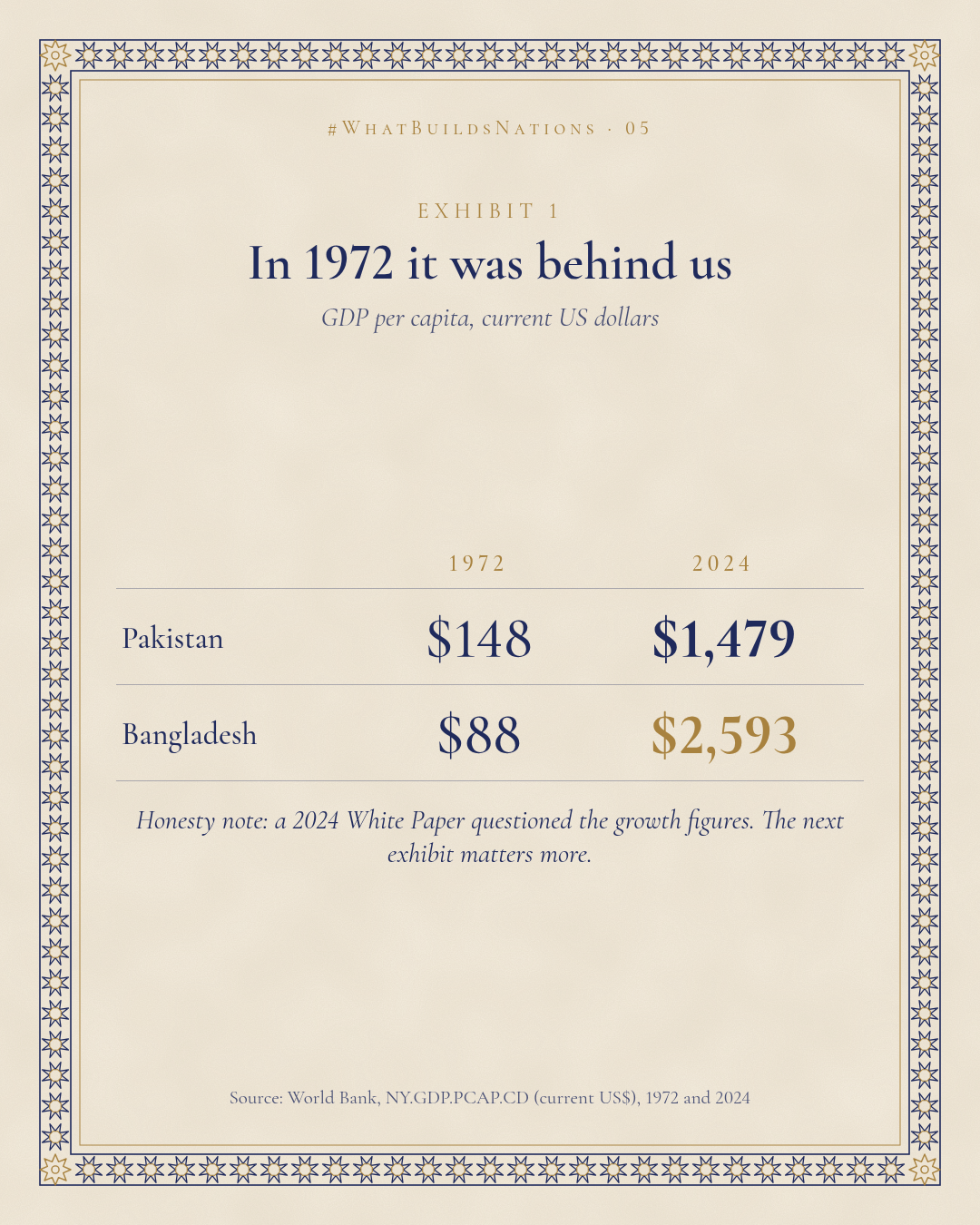
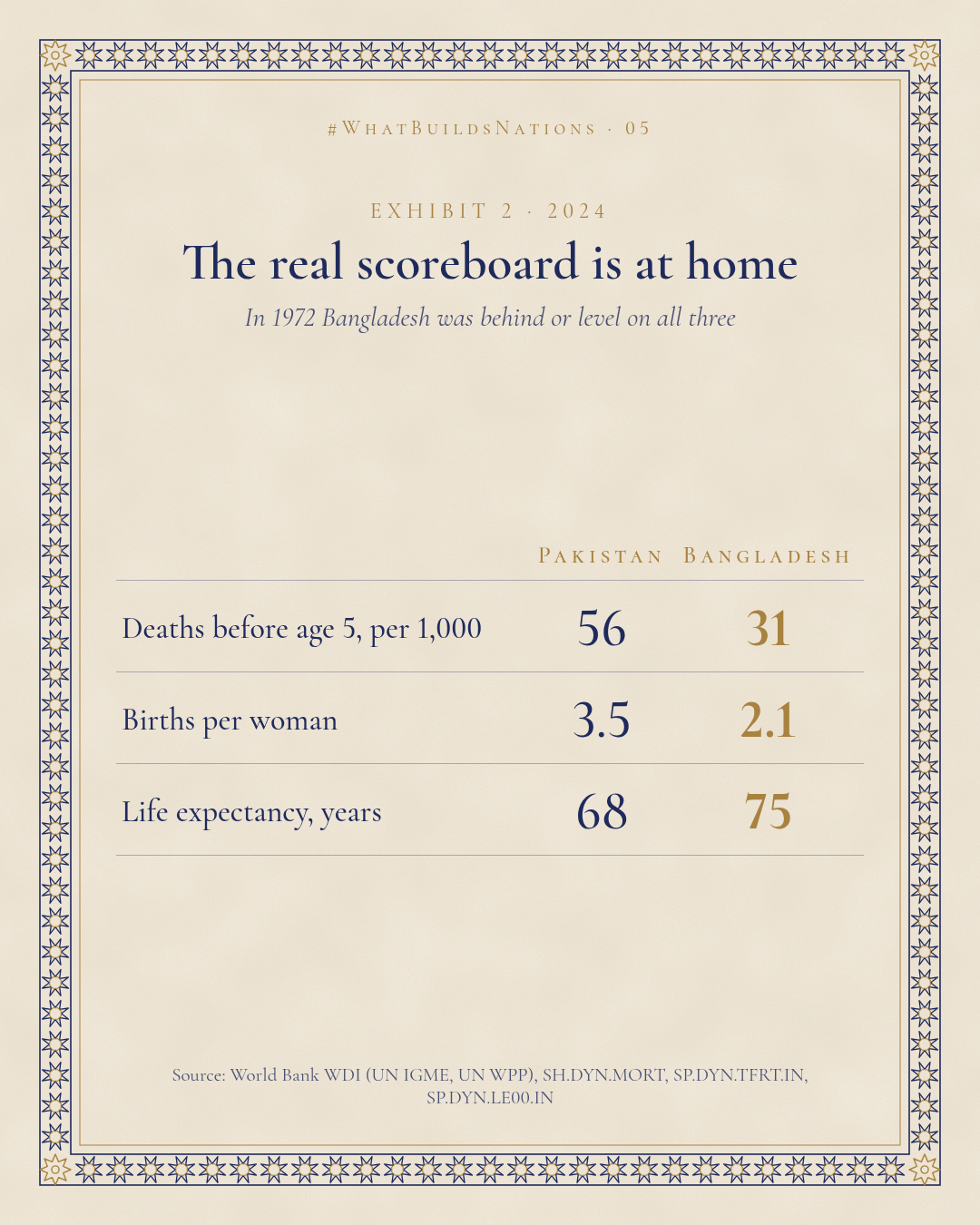
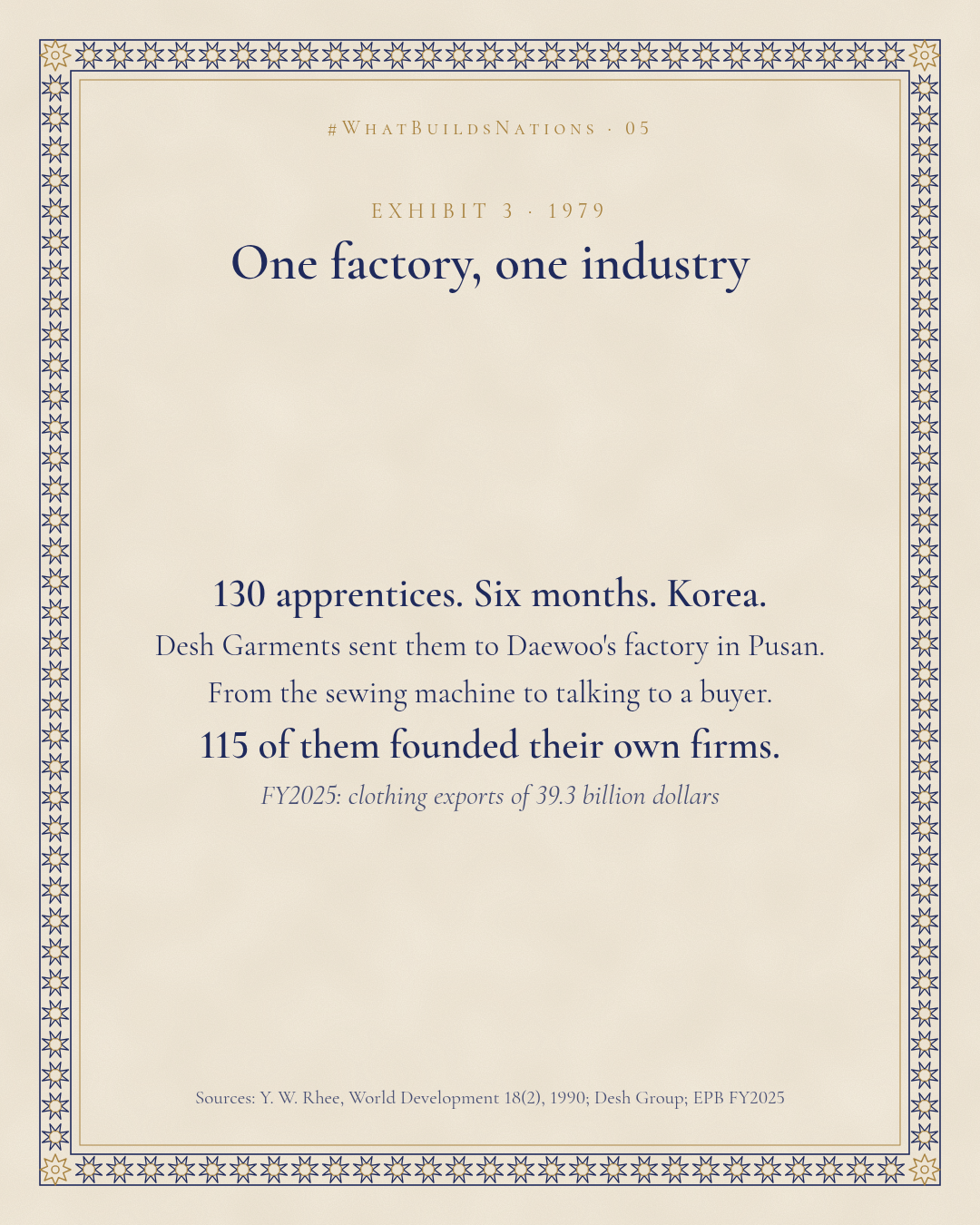
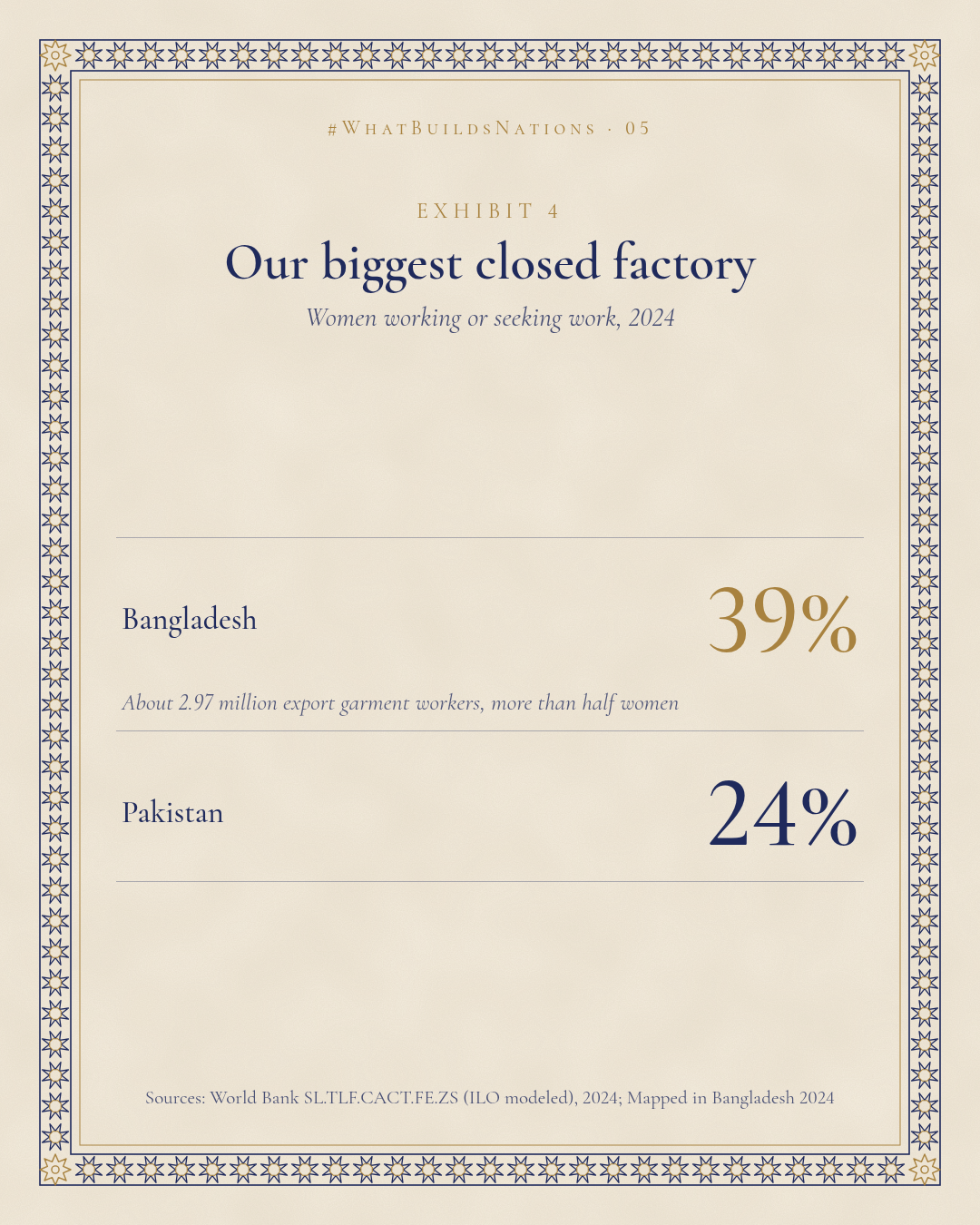
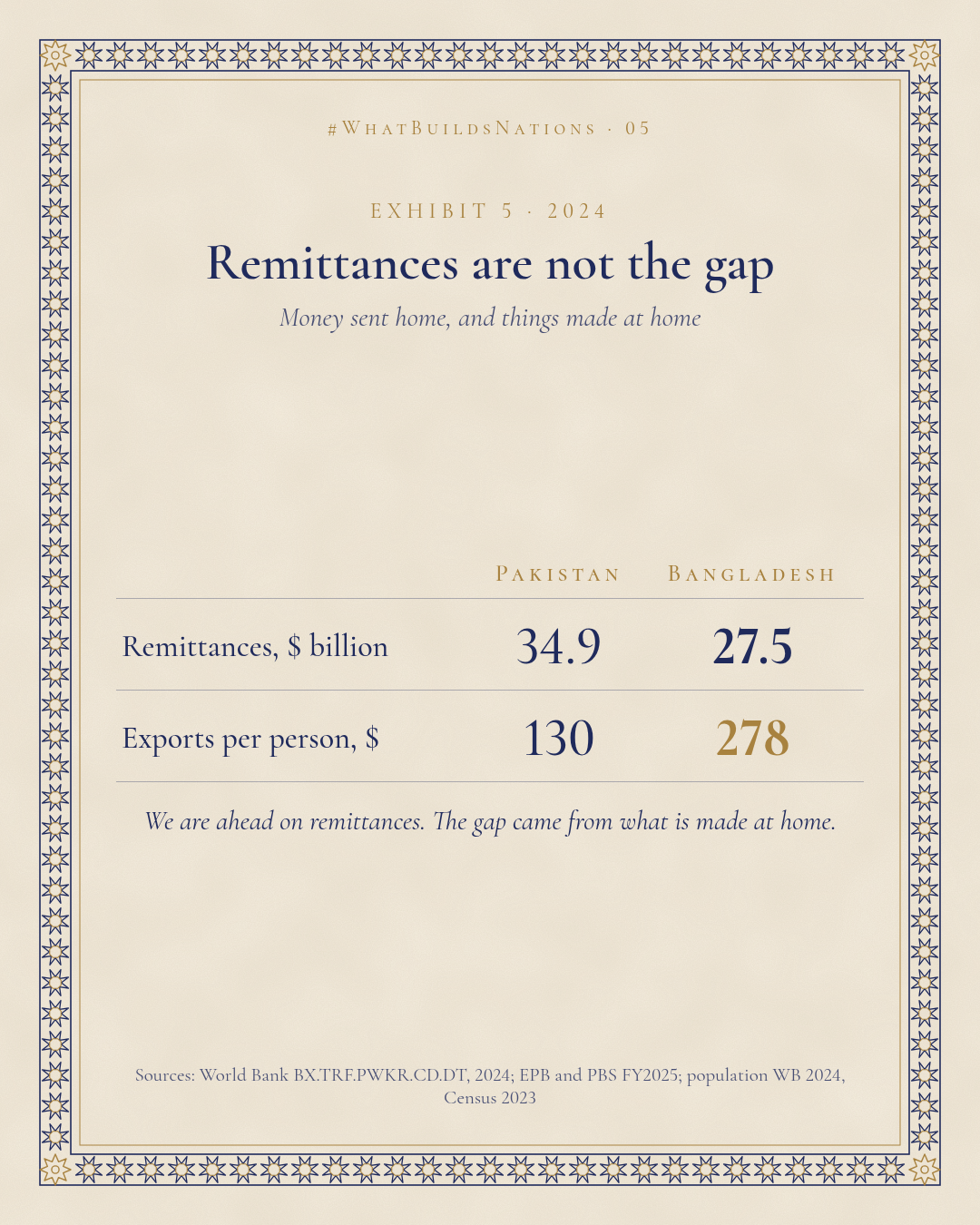
Exhibit 1. GDP per capita, current US dollars
| Year | Pakistan | Bangladesh |
|---|---|---|
| 1972 | 148 | 88 |
| 1990 | 344 | 283 |
| 2000 | 642 | 397 |
| 2010 | 987 | 757 |
| 2016 | 1,425 | 1,649 |
| 2024 | 1,479 | 2,593 |
A note of honesty. In this series Bangladesh passes Pakistan in 2016, and the jump from 2015 to 2016 is unusual. The December 2024 White Paper also questioned the growth figures. That is why the next exhibit matters more. Source: World Bank.
Exhibit 2. The foundation, measured at home
| Pakistan 1972 | Bangladesh 1972 | Pakistan 2024 | Bangladesh 2024 | |
|---|---|---|---|---|
| Deaths before age five, per 1,000 births | 184 | 229 | 56 | 31 |
| Births per woman | 6.8 | 6.8 | 3.5 | 2.1 |
| Life expectancy, years | 54 | 50 | 68 | 75 |
Exhibit 3. Women in the labour force, percent
| Year | Pakistan | Bangladesh |
|---|---|---|
| 1990 | 11 | 24 |
| 2024 | 24 | 39 |
Exhibit 4. One factory, one industry
| 1979, trained at Daewoo in Pusan | 130 people, six months |
| Of them, set up their own firms | 115 |
| Export garment factories today | about 3,300 |
| Workers in them today | about 2.97 million, more than half women |
| Clothing exports, FY2025 | 39.3 billion dollars, 81 percent of all exports |
Exhibit 5. Remittances and exports, 2024
| Pakistan | Bangladesh | |
|---|---|---|
| Remittances | 34.9 billion dollars | 27.5 billion dollars |
| Exports per person | about 130 dollars | about 278 dollars |
On remittances we are ahead. The gap came from what is made at home.
The last word
There is no single hero in Bangladesh’s story.
There is a mother who learned to mix salt and molasses. A girl who met the stipend’s conditions and finished school before marriage. And a woman worker who carries her salary home on the first of every month.
Counting salaries in my own company taught me that real impact accumulates one month at a time.
Bangladesh repeated that lesson in three million salaries, every month, for forty years.
In 1972 it was behind us. Today’s gap was not written by fate.
And closing it is in the hands of our women, if we give them the chance.
Three questions for you
- What most stops women in Pakistan from reaching work? The commute? The home? The workplace?
- Of Desh’s 130 apprentices, 115 started their own companies. Which of our sectors could do that, and what is stopping it?
- Bangladesh paid for its rise with low wages, Rana Plaza and dependence on one industry. Can we take this road without that price?
Next in the series
Malaysia.
A Muslim country, many peoples, one direction.
How it held growth and unity together after the riots of 1969, and where it slipped. On Thursday.
Sources
- World Bank, World Development Indicators: GDP per capita, current US$ (NY.GDP.PCAP.CD) 1972 to 2024; under-5 mortality (SH.DYN.MORT); fertility (SP.DYN.TFRT.IN); life expectancy (SP.DYN.LE00.IN); female labour force participation, modeled ILO estimate (SL.TLF.CACT.FE.ZS); personal remittances received (BX.TRF.PWKR.CD.DT) 2024; population (SP.POP.TOTL) 2024.
- White Paper Committee on the State of the Bangladesh Economy (chaired by Debapriya Bhattacharya), December 2024.
- Foreign Relations of the United States 1969 to 1976, Vol. XI, Document 235: Washington Special Actions Group meeting, 6 December 1971 (“international basket case”).
- Yung Whee Rhee, “The catalyst model of development: Lessons from Bangladesh’s success with garment exports”, World Development 18(2), 1990.
- Desh Group, Founder Story and Who We Are (Desh Garments, Daewoo agreement 1978, Pusan training).
- Export Promotion Bureau Bangladesh and BGMEA: FY2024-25 exports 48.28 billion dollars, RMG 39.35 billion (81.49 percent).
- Mapped in Bangladesh (BRAC University CED), 2024: 3,320 export RMG factories, 2,969,068 workers, 57 percent women.
- BRAC, Oral Therapy Extension Programme 1980 to 1990; Chowdhury and Cash, “A Simple Solution” (1996).
- Grameen Bank monthly report, December 2025: 10,820,094 members, 10,460,283 women; Nobel Peace Prize 2006.
- Asian Development Bank, South Asia Working Paper 81: The Female Secondary Stipend and Assistance Program in Bangladesh.
- ILO on Rana Plaza (24 April 2013) and Tazreen (24 November 2012); Accord on Fire and Building Safety in Bangladesh (2013).
- Minimum Wage Board and government gazette, December 2023: RMG minimum wage 12,500 taka.
- UN Committee for Development Policy and ECOSOC, 2026: LDC graduation in November 2026 and the deferral request.
- Pakistan Bureau of Statistics, FY2025 exports 32.1 billion dollars; Census 2023.
Waqas Khan Pitafi
Founder and CEO of DevBatch since 2010. Sixteen years building one engineering services firm, from Pakistan, now in Dallas.
Keep reading
- October 25, 2026 · 11 min
ملائشیا: کئی قومیں، ایک سمت
قوموں کی تعمیر پر ایک سلسلہ، قسط 6: 1969 کے فسادات کے بعد ملائشیا نے دولت بڑھانے اور بانٹنے کا فیصلہ کیا۔ ساٹھ سال کے مسلسل منصوبے، Penang کے chips، Petronas اور Vision 2020۔ پھر نسلی کوٹے اور 1MDB۔ تسلسل اور اعتماد کا case۔
- October 25, 2026 · 10 min
Malaysia: Many Peoples, One Direction
Part six of a Harvard-style case series on what builds nations: after the 1969 riots Malaysia chose to grow and share its wealth. Sixty years of unbroken plans, Penang's chips, Petronas and Vision 2020, then race quotas and 1MDB. A case in continuity and trust.